
Nobody expects to laugh and scream at the same time, but that is exactly what happens on the Ganga. Most first-timers show up a little nervous, wondering if the whole thing is too wild for them. It usually is not. River rafting in Rishikesh sounds scarier than it really is, and with a good guide and the right gear, a beginner can enjoy every splash. Still, this is a powerful Himalayan river, so the people who have the best day are the ones who come prepared. If you are planning river rafting in Rishikesh for the first time, this guide covers the season, the routes, the safety rules and what actually happens when the raft hits a big wave. Think of it as everything you would want to know before your first rafting trip in Rishikesh.
The Moment Before the First Rapid
Picture this. It is 9 a.m., the water is cold, and the guide is walking you through the paddle commands on a sandy beach. Someone in your group is nervously adjusting a helmet that already fits. Then you push off, and for ten minutes the Ganga is calm and wide and almost peaceful.
Then the guide calls out, “Forward paddle!” and the river changes character.
That small gap between calm and chaos is the whole appeal. And it is why beginners do well here. The river gives you time to settle in before it asks anything of you.
Why Rishikesh Works So Well for First-Timers
Rishikesh sits at the point where the Ganges leaves the Himalayan foothills and heads toward the plains. That geography gives the river a mix of fast, splashy sections and long, easy stretches where you can float and look around. You get the thrill without being thrown into extreme water on day one.
The town also has plenty of choice. Short routes suit families and nervous first-timers. Longer routes suit people who want a full day on the water. You can pick your level and grow into it on later trips.
When to Go (and When Not To)
Timing matters more than most beginners realise.
Rafting is closed during the monsoon. Operators stop around the end of June, and the river is only reopened after officials inspect the water level and rapids. This year, rafting restarted on the Ganga on 23 September 2026, with a traditional pooja on the river. So as of mid-October, the season is open.
A rough guide to the months:
- October to November: The river is lively and the weather is pleasant. This is a popular window, so book early.
- December to February: Cold air and cold water. You will need proper warm layers, and many operators provide wetsuits or thermal gear. It is quieter and clear, but not for people who dislike the cold.
- March to June: Warmer days and good water. Mornings are best in summer, before the heat builds.
One more thing worth knowing: the river can still be paused outside monsoon months if the level rises sharply. This has happened in late June in recent years. If your dates are close to the season edges, check with your operator a day or two before you travel.
Choosing Your Route
Routes are named by their starting point, and they all finish near Rishikesh. Distances vary slightly depending on who you ask, so treat these as approximate.
River Rafting Routes in Rishikesh: Distance and Prices
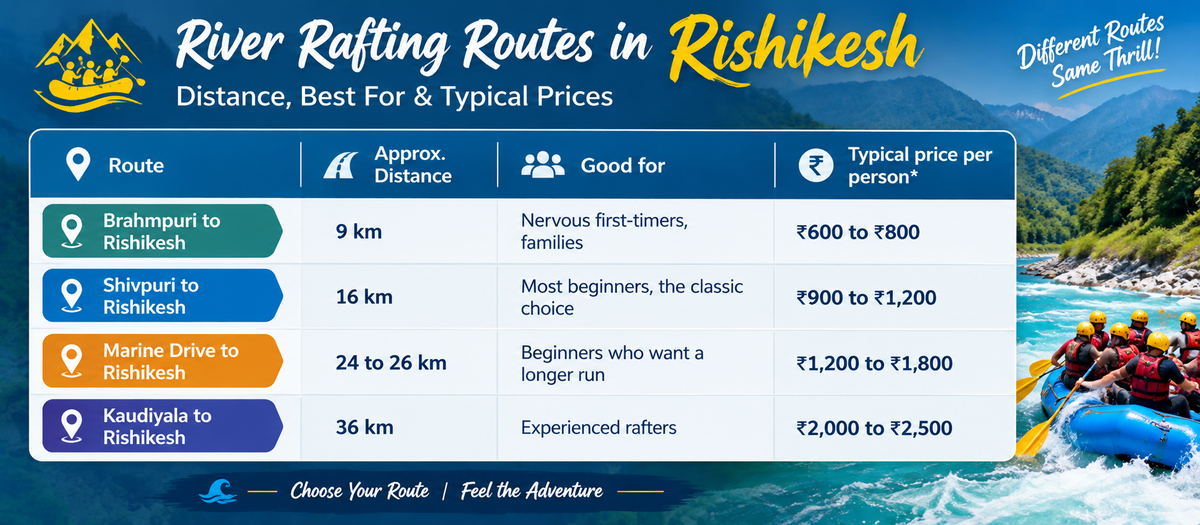
*Prices are approximate and change by operator, season and what is included. Always confirm before you pay.
My honest advice for beginners: start with Shivpuri. It has the famous rapids, it takes a couple of hours, and it feels like a proper adventure without being overwhelming. Skip Kaudiyala for now. It includes tougher rapids like The Wall and is generally meant for people with some experience.
The Rapids You Will Hear About
Guides love naming rapids, and the names stick. On the Shivpuri stretch you will likely run:
- Return to Sender: A gentle warm-up.
- Three Blind Mice: Fun, splashy, and a good place to find your rhythm.
- Roller Coaster: A series of rolling waves that really does feel like a ride.
- Golf Course: One of the bigger ones on this route.
- Club House: Another popular rapid before the finish.
Rapids are graded by difficulty. If you want to understand what a “Grade III” or “Grade IV” actually means, the International Scale of River Difficulty explains how rivers and rapids are rated. The American Whitewater version also makes an important point: a river’s difficulty can change with water level and weather, so the same rapid can feel different from one month to the next.
For beginners, most commercial routes sit in the Grade II to IV range, depending on the stretch and the water level.
Safety Rules You Should Not Skip
Here is the part that matters most. Rafting in Rishikesh is regulated, and it should be. Local authorities have said repeatedly that life jackets and trained guides are the foundation of safety. For this season, the rules highlighted include:
- Licensed operators only. Registered rafting firms must hold licences.
- Trained river guides must be on every raft.
- Helmets and certified life jackets are mandatory.
- No overloading. A raft cannot carry more people than its rated capacity.
Officials have also acknowledged that people have died in earlier seasons, which is exactly why gear checks are taken seriously now. You should take them seriously too.
Before you book
- Ask if the company is licensed. A reputable operator will answer immediately and without hesitation.
- Ask about the guide. How long have they guided this stretch? Are there safety kayakers following the rafts?
- Check the gear yourself. The life jacket should fit snugly. If you can lift it up past your ears, it is too loose. The helmet should not wobble.
- Be honest about your health. If you are pregnant, have a heart condition, back or neck problems, or a recent injury, speak to a doctor first.
On the river
- Listen to the safety talk. It feels repetitive. It is also the most useful ten minutes of your day.
- Learn the commands. “Forward,” “back,” “stop,” and “get down” are the usual ones. Follow them instantly.
- Hold your paddle properly. Keep one hand on the T-grip at the top so it never swings into someone’s face.
- Keep your feet secure in the raft’s footholds, and stay seated when told to.
If you fall in
Almost everyone worries about this, and it is less dramatic than you think. Life jackets keep you afloat. What matters is how you react.
- Do not panic or fight the current.
- Float on your back with your feet up and pointing downstream. This protects your head and keeps your legs from catching on rocks.
- Never try to stand up in fast water. Your foot can get trapped between rocks, which is genuinely dangerous.
- Look for the guide’s rope or paddle, and grab it when it comes to you.
- Let go of your paddle if holding it makes things harder.
Two firm rules
Do not drink before rafting. Rishikesh is a vegetarian and alcohol-free town anyway, but it needs saying. And do not jump off cliffs or rocks along the river unless your operator explicitly allows it. Cliff jumping has been restricted in recent seasons, and it is not worth the risk.
What to Wear and Bring
Keep it simple.
- Quick-dry clothing: Synthetic shorts, a t-shirt or rash guard. Avoid cotton jeans, which get heavy and cold when wet.
- Secure footwear: Sports sandals with a back strap work well. Flip-flops will wash away.
- Sun protection: Sunscreen and sunglasses with a strap.
- A change of clothes and a towel waiting at the finish.
- Warm layers in winter: Ask the operator what they provide.
Leave your phone, wallet and jewellery behind, or use a proper waterproof pouch. Most operators offer photos or action-camera footage, so you can actually enjoy the ride instead of worrying about your phone.
Do You Need to Know How to Swim?
Not necessarily. Many operators say no swimming skill or prior rafting experience is needed for beginner stretches, and a life jacket keeps you afloat. But being comfortable in water helps you stay calm if you do fall out. If you are very anxious, tell your guide at the start, choose a shorter route, and sit in the middle of the raft.
Age limits vary by operator. Around 14 years is commonly quoted, though some allow younger children on the gentlest stretch. Ask before you book.
What the Day Looks Like
A typical beginner trip runs roughly like this:
- Pickup and drive to the starting point.
- Gear fitting and safety talk on the riverbank.
- Practice paddling in calm water.
- The run itself, usually one to three hours depending on the route.
- Floating or body-surfing break in a calm section if your guide offers it.
- Drop-off, tea and a change of clothes.
Standard rafting hours are roughly 9 a.m. to 5 p.m. Mornings are usually better in warm months.
A Quick Note on Respecting the River
The Ganga is sacred to millions of people. Do not litter, do not throw anything into the water, and keep noise reasonable near ghats and temples. Good operators take this seriously. It is a small way to say thank you for the ride.
Final Thoughts
Your first rapid will probably feel like it lasts ten seconds and ten minutes at the same time. You will come out wet, a little breathless, and grinning. That is the real appeal of river rafting in Rishikesh: it is exciting enough to remember and manageable enough to enjoy, as long as you respect the river and choose your operator carefully.
Check the season, pick a beginner route, ask the right safety questions, and listen to your guide. The river will do the rest.
Frequently Asked Questions
Is river rafting in Rishikesh safe for beginners?
It can be, when you use a licensed operator, trained guides and proper gear, and when you follow instructions. No adventure sport is risk-free, which is why the rules above matter.
Which route is best for a first-timer?
Shivpuri to Rishikesh (about 16 km) is the most common choice. Brahmpuri is a gentler option if you want something shorter.
Can I go rafting in July or August?
No. Rafting is suspended during the monsoon for safety.
How long does rafting take?
Anywhere from about one hour on short routes to five or six hours on the longest stretch.


